This post covers the technical and theoretical differences between Edge Functions and traditional Serverless Functions (like AWS Lambda). We are going to explore how they differ in runtime architecture, performance characteristics, and show 2 simple use cases.
What are Edge Functions?
At its core, an Edge Function is a piece of code that executes as close to the user as possible. Unlike traditional cloud functions that run in a specific "Region" (Northern Virginia - us-east-1), Edge Functions are deployed globally across a Content Delivery Network (CDN). When a user makes a request, the code executes at the Point of Presence (PoP) nearest to them.
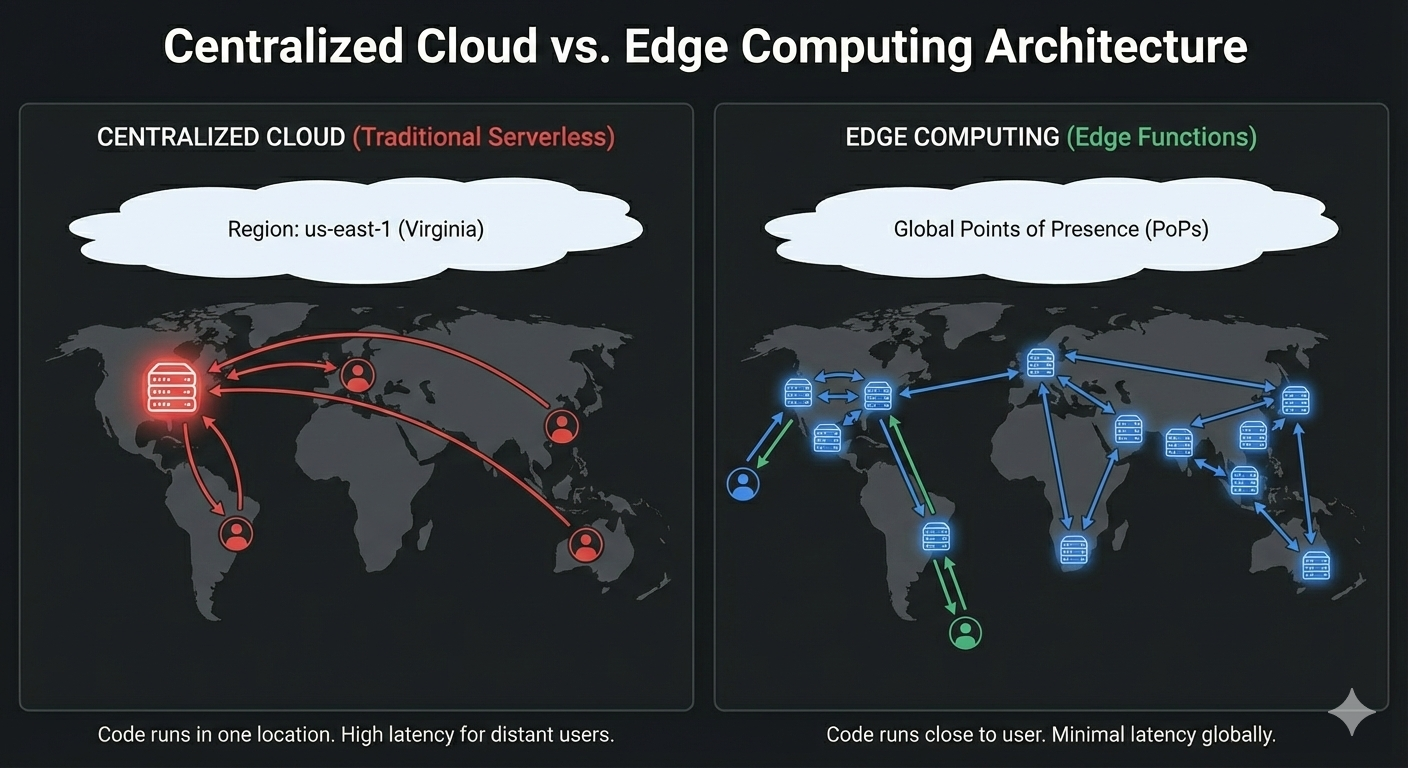
"Isolates" vs. Containers
To understand Edge Functions, we should first understand the runtime technology. Most traditional serverless functions (like AWS Lambda) use Containers or Firecracker MicroVMs. When a function is triggered, the provider spins up a mini-server (container). This is powerful but heavy. Edge Functions (like Cloudflare Workers or Vercel Edge) typically use V8 Isolates.
- What is an Isolate? Instead of booting a whole operating system or container, the runtime spins up a secure, isolated context within a single existing process.
- The Benefit: This eliminates the overhead of an OS boot. Isolates can spin up in microseconds, effectively eliminating the "Cold Start" problem.
What are "Traditional" Serverless Functions?
"Serverless" usually refers to Function-as-a-Service (FaaS) offerings like AWS Lambda, Google Cloud Functions, or Azure Functions. These are centralized compute units. The user selects a region, deploys their code, and the cloud provider handles the scaling. They are event-driven and ephemeral but generally run in a heavier environment than edge functions. Some key characteristics are:
- Region-Specific: You choose where they live.
- Full Runtime: You get a full Node.js, Python, or Go environment.
- Access to Power: You have access to the file system (
/tmp), native binaries, and TCP sockets for long-running database connections.
Edge vs. Serverless
Here we are going to compare four critical dimensions.
Latency & Network Topology
- Serverless: If your user is in Paris and your function is in
us-east-1(Virginia), the request must travel across the Atlantic, process, and return. The speed of light imposes a hard floor on latency (~80-100ms minimum). - Edge: The code runs in a Paris data center. The network travel time is negligible (often <10ms).
Cold Starts
- Serverless: If your function hasn't run in a while, the provider must "boot" the container.
- Impact: 100ms to 2+ seconds of delay.
- Edge: Because they use V8 Isolates (or WebAssembly), there is no OS to boot.
- Impact: Near-zero cold starts (single-digit milliseconds).
Runtime Environment & Limitations
This is where the "theoretical" constraints become practical roadblocks.
| Feature | Serverless (Lambda/Node.js) | Edge Functions (V8/Workers) |
|---|---|---|
| Runtime | Full Node.js/Python environment. | Limited Standard Web APIs (Fetch, Request, Response). |
| NPM Support | nearly all packages work. | Many packages fail (especially those relying on Node internal modules like fs, net, or native binaries). |
| Execution Limit | Long (15 mins on Lambda). | Short (Often 10ms–30s depending on provider). |
| Code Size | Large (50MB+ zipped). | Tiny (Often < 1MB-5MB). |
Data Connectivity (The "Database Paradox")
This is often the most confusing aspect of Edge computing. If Edge functions are so fast, why are they considered "bad" for database operations?
The Physics Problem: When you connect to a standard database (Postgres/MySQL) via TCP, two things kill performance at the Edge:
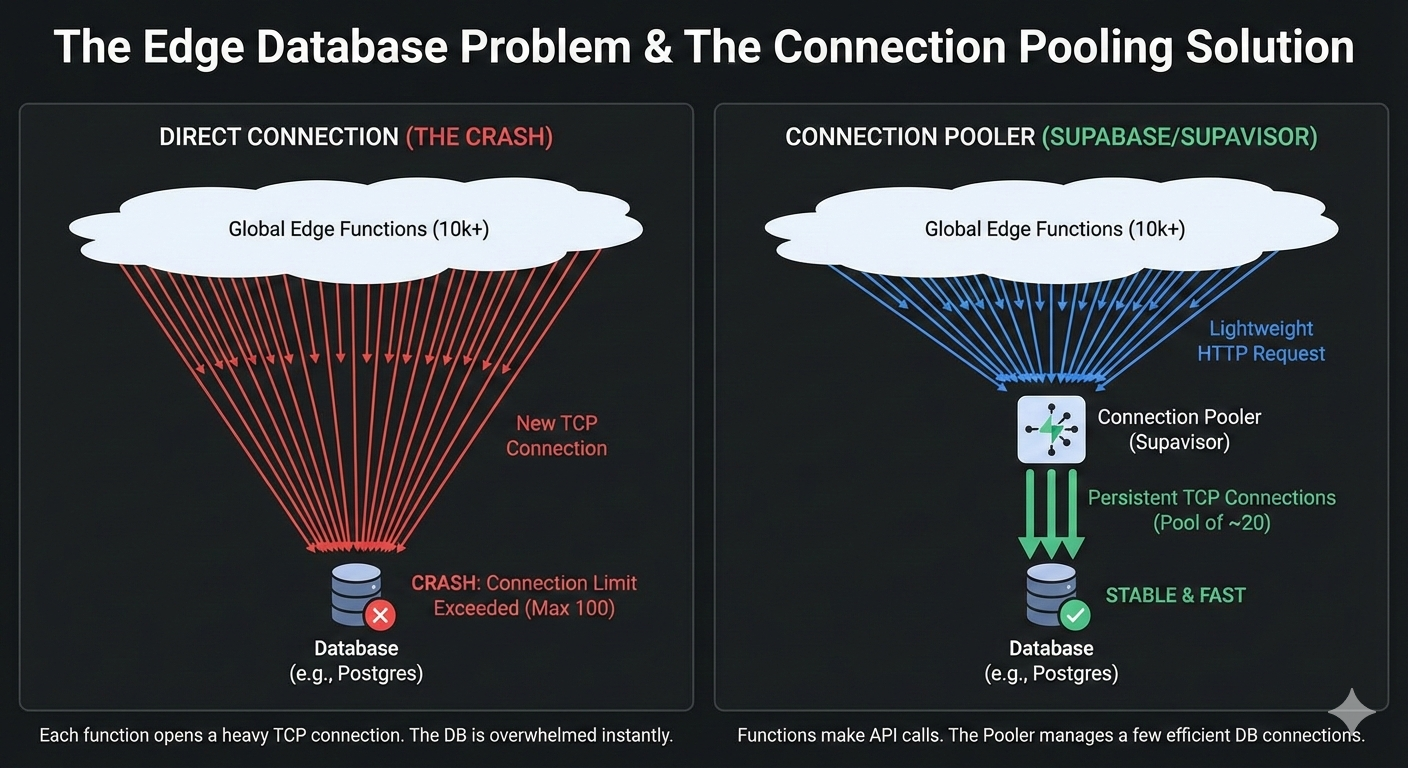
- Connection Exhaustion: Edge functions scale infinitely. If 10,000 users visit your site, 10,000 functions spin up. They will instantly exhaust the connection limit of a standard database (often limited to ~100 connections).
- Handshake Latency: Setting up a secure TCP connection requires a "handshake." If your function is in Tokyo and your DB is in Virginia, the handshake requires multiple round-trips across the ocean before the query is even sent.
The Solution (e.g., Supabase, Neon): Modern "Serverless Databases" solve this by abandoning raw TCP connections in favor of HTTP/REST and Connection Pooling.
- HTTP over TCP: Instead of a persistent connection, the Edge function makes a lightweight HTTP request (like a REST API call).
- Connection Pooling: A middleware (like Supabase's Supavisor, see Figure 1 below) sits in front of the database. It manages the heavy TCP connections and serves the lightweight Edge requests, preventing the database from crashing.
When to use which?
Do not default to Edge just because it is "faster." It is often more restrictive. A useful guide is:
Use Edge Functions When:
- Request Manipulation: You need to modify HTTP headers, rewrite URLs, or perform A/B testing redirections before the request hits your server.
- Personalization: You are injecting user-specific data (like "Welcome, User from Bulgaria") into a cached page.
- Authentication: Validating JWT tokens at the edge to reject unauthorized requests without hitting your main servers.
- Geolocation: Serving different content based on the user's country.
Use Serverless Functions When:
- Heavy Compute: Image processing, video transcoding, or massive data aggregation.
- Complex Database Operations: Transactions involving centralized SQL databases or legacy systems.
- Long-Running Tasks: Web scrapers or background jobs that take minutes to complete.
- Node.js Dependency: You need specific libraries that rely on native OS binaries
Example Use Cases
We are going to illustrate two simple use cases: one for when to use an Edge Function, and one for when to use a Serverless Function.
Use Case 1: Edge Function (A/B Testing Middleware)
Why here? This logic needs to happen before the site loads. Waiting for a centralized server in Virginia to decide which version of the site a user in Tokyo sees adds unnecessary latency.
The Code (Conceptual JavaScript/Next.js Middleware):
// This runs on the Edge (e.g., Cloudflare Workers or Vercel Edge)
import { next } from '@vercel/edge';

export default function middleware(request) {
  // 1. Get the user's location from the incoming request
  const country = request.geo.country || 'US';

  // 2. Define the buckets
  // 50% chance to see the 'new-feature' bucket
  const bucket = Math.random() < 0.5 ? 'legacy' : 'new-feature';

  // 3. Rewrite the URL based on the bucket
  // The user sees "example.com" but we silently serve "example.com/b"
  const url = request.url;

  if (bucket === 'new-feature') {
    url.pathname = `/new-feature${url.pathname}`;
  }

  // 4. Return the response instantly
  // We add a header so the client knows which bucket they are in
  return next(url, {
    headers: {
      'x-ab-bucket': bucket,
      'x-user-location': country
    }
  });
}
Key Takeaway: This executes in milliseconds. It uses standard Web APIs (request, url) rather than Node.js specific APIs.
Use Case 2: Serverless Function (Image Processing)
Why here? Resizing images requires heavy CPU power and native binaries (like sharp or imagemagick). Edge functions usually have strict size limits (e.g., 1MB script size) and cannot run these heavy binaries.
The Code (Node.js / AWS Lambda style):
// This runs in a Container (e.g., AWS Lambda)
const sharp = require('sharp'); // Heavy native library
const AWS = require('aws-sdk');
const s3 = new AWS.S3();

exports.handler = async (event) => {
  const bucket = event.Records[0].s3.bucket.name;
  const key = event.Records[0].s3.object.key;

  // 1. Fetch the raw image from S3 (File System access)
  const inputImage = await s3.getObject({ Bucket: bucket, Key: key }).promise();

  // 2. Perform heavy compute (Resize)
  // This might take 500ms - 2s depending on image size
  const resizedImage = await sharp(inputImage.Body)
    .resize(width: 800)
    .toFormat('jpeg')
    .toBuffer();

  // 3. Save the result back to storage
  await s3.putObject({
    Bucket: bucket,
    Key: `resized-${key}`,
    Body: resizedImage
  }).promise();

  return { status: 'success', message: 'Image resized' };
};
Key Takeaway: This script uses require('sharp'), a heavy dependency that wouldn't work in a V8 Edge environment. It also performs asynchronous file I/O operations that can take several seconds without timing out.
Conclusion
Edge Functions eliminate cold-start latency by executing in V8 Isolates deployed globally across CDN points of presence, reducing response time by 10-100ms compared to centralized serverless functions. However, their tight execution constraints—sub-30 second timeouts, sub-5MB code limits, and limited persistent connections—restrict them to stateless, I/O-light operations: request routing, authentication, header manipulation, and geolocation-based content delivery. For latency-sensitive decisions at the network perimeter, Edge Functions provide measurable performance gains; for workloads requiring database access or heavy computation, they are fundamentally unsuitable.
Comments